Archive | News RSS feed for this section

Chilean President Makes Emergency Landing After Helicopter Runs Out of Fuel

1 Feb

President of Chile Sebastian Pinera made an unscheduled, emergency landing, by himself after his helicopter ran out of fuel. Pinera, who gained international attention during the rescue of the Chilean miners in 2010, landed his helicopter on a busy, public highway near Cobquecura. Once the helicopter landed, Pinera asked local people where he was and requested that a police helicopter bring him additional fuel.

Pinera has been a pilot for five years, and vows to continue flying until his license runs out. Members of the opposition condemned his actions as irresposible.

“It cannot be possible that Mr Pinera, even though he is president, can land wherever in the country, putting people’s safety at risk,” said Gabriel Asencio of the opposition Christian Democrats to the BBC.


Introducing the Tumbeasts

31 Jan

The Internet is a crazy place. For the latest example, look at the story of Matthew Inman, creator of the popular web comic “The Oatmeal.” Last week, coinciding with the timing of President Obama’s “State of the Union” address, Inman published his “State of the Web” comic (hilarious, by the way).  In one of the panels, he references the infamous day that Tumblr went down for more than 12 hours, robbing thousands of bloggers of the ability to update their sites.

He suggests blaming future outages on an imaginary animal like Twitter has previously done with the “Fail Whale.” His suggests adopting his newest creation, the TumblBeasts, as the face for future outages.

Four hours later, the head of Tumblr contacted about Inman about using the “animal” for the official 503 error page. Inman agreed, and Tumblr renamed them “Tumbeasts.” The story was picked up by national media. Today, he posted another comic, which both celebrates and pokes fun at his newest creation. Keep drawing dude!

Man Sues Facebook for $500K Because They Shut Down His Account

31 Jan

A Staten Island man claims that Facebook shut off access to his personal photos and his friends overseas when it closed his account for no reason. He asks for $500,000 and the restoration of his account in his lawsuit.

Mustafa Fteja, 39, had 340 friends on the site, which averages out to $1,470 per friend if his suit succeeds. An immigrant from Montenegro 19 years ago, Fteja claims that Facebook was one of his primary ways to communicate with them.

He told The New York Post, “I’m not doing this for money. I’m doing this for justice. I know one thing — I didn’t do anything. I didn’t violate anything.” He claims to have contacted the company several times, but only received a form letter in response, claiming he violated the company’s user agreement.

Spam Text Prevents New Years Eve Massacre in Red Square

28 Jan

One of Russia’s most popular newspapers claims a potentially devastating New Years Eve suicide bombing was prevented only because the would-be-bomber received a spam message that caused her weapon to detonate early.

The woman, who belonged to the same group as the suicide bombers that attacked a Moscow airport earlier this week, planned to detonate the bomb in Red Square during the New Years Eve celebrations. If successful, the bomb could have killed hundreds of people. Just hours before the planned attack, the woman’s mobile carrier sent her a “Happy New Year” text message that caused the device to detonate.  She received the message while in her apartment, and the blast shattered windows nearby.

Islamic terrorists in Russia frequently use explosives that are detonated by text message. The technique allows for a handler to watch the bomber, and detonate the device when it can cause the maximum number of causalities possible.

How Egypt Cut Off the Internet

28 Jan

Update: A reader sends me the following tip, “the AP released a video: http://apne.ws/hgEg4d, of a man being shot in the head. 10 minutes later the internet went down.” (CAUTION: graphic video)

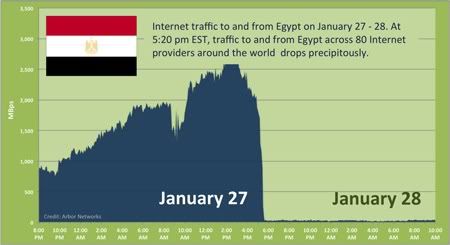
First, the visual. From DailyKOs:

So, it appears that around 5:20 EST on January 27 something happened that caused most of the country to lose internet access. Later in the blog post on KOs, we learn that the number of active internet connections dropped from an average of 80,000 active connections at any given time  to 100 total, overnight.

Renesys, a company that monitors internet traffic worldwide, called the action “unprecedented in Internet history.” Time provides a well-written, comprehensible analysis of how the country managed to shut off access. The Wall Street Journal has another, more technical, account.

In spite of these odds, some information still appears to be leaking out of the country.  One computer science professor somehow managed to update his Facebook page and another journalist has been able to tweet.

Beyond the political implications of this story, which seem potentially historic, the use of a “kill switch” on the Internet inside a country will also make technology history.